Designing the future: How AI changes the way we lead

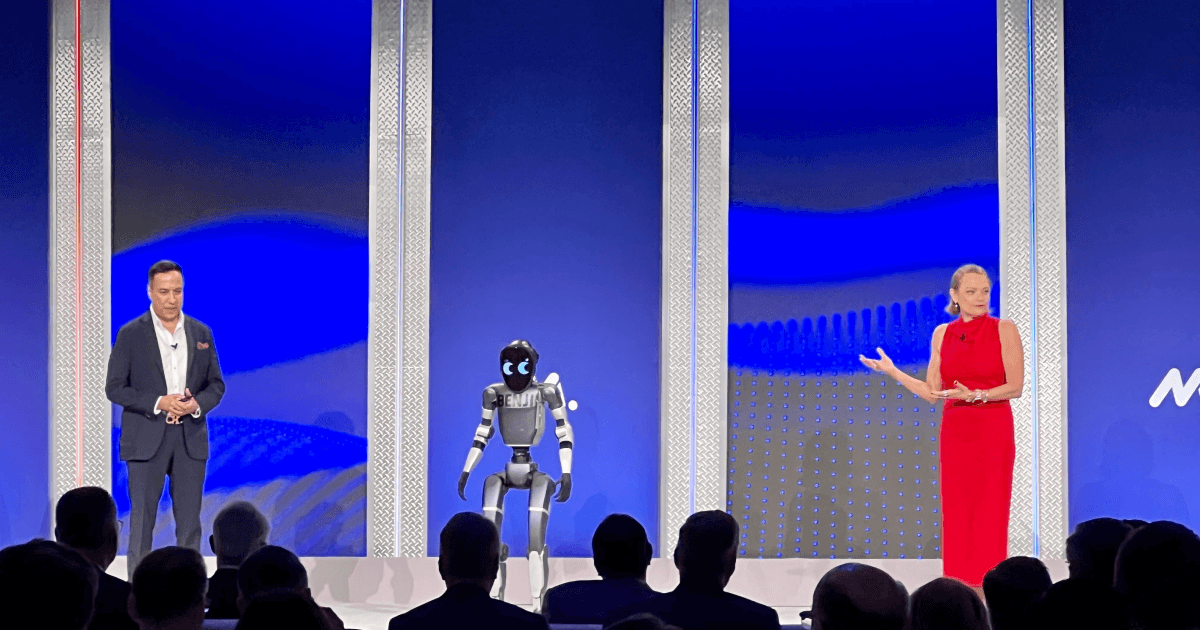

Recently, I had the honor to co-present with Prasoon Saxena, Global Leader of Products Industries at NTT DATA, at the National Association of Manufacturers (NAM) annual board event. This was an incredible gathering of prominent American manufacturing leaders sharing ideas and shaping the future of the industry.
Our talk, Designing the future: How AI changes the way we lead, explored three key themes critical for leaders in Manufacturing: Scaling AI across the value chain, Workforce transformation and Leadership responsibility & AI mindset.
In my segment on Workforce Transformation, I emphasized that a human-first approach is foundational to building the workforce of the future in manufacturing. Attracting and retaining talent remains a critical challenge—67% of manufacturers cite it as their top concern, according to NAM’s Q2 2024 Manufacturers’ Outlook Survey. While recruitment is critical, business leaders are also seeking ways to reshape today’s manufacturing job responsibilities; reskilling employees and implementing new AI tools and redefining what day to day looks like on both the factory floor and the front office.
This results in Manufacturing leaders facing multiple friction points: AI promises productivity, new ways of working and modernization. But workers fear replacement and middle management fears loss of control. Solving this tension starts with understanding that these are human problems; and the most effective AI transformations are human transformations.
Rethinking resistance
What often gets labeled as resistance to AI or automation usually isn’t resistance at all. It’s a lack of trust or a lack of involvement. When people feel technology is happening to them instead of being built with them, they disengage. Not because they’re anti-technology, but because experience has taught them that change often adds work instead of removing it. For manufacturing leaders charged with workforce transformation, it’s about deciding, very intentionally, where human judgment still matters most.
AI is most powerful when it removes the invisible work that exhausts people: chasing information, filling gaps between broken systems and carrying years-worth of institutional knowledge in their heads. That cognitive and administrative load is where burnout lives. And it’s where AI can create immediate, measurable impact.
A system under strain
Right now, manufacturing is dealing with skilled labor shortages and an aging workforce at the same time. The National Association of Manufacturers has noted that one-quarter of the manufacturing workforce is over 55 years old and the U.S. faces a shortfall of 1.9 million manufacturing workers by 2033. The time it takes for a new hire to become fully proficient is longer than most operations can afford. And in many cases, institutional knowledge is literally walking out the door. All while expectations aren’t easing: productivity targets are higher and safety standards are tighter. Supply chains are more volatile and quality is under more scrutiny. The system is being asked to perform at a higher level, with less margin for error and with less experienced capacity.
A rapidly changing workforce
The workforce entering manufacturing today is not the same workforce we designed our systems around 20 or 30 years ago. Gen Z expects clarity around standards, progression and feedback, with a visible path to proficiency and advancement. As a digital-first cohort, they want and expect the technology they use at work to feel intuitive and seamless. If manufacturers fail to attract this talent, the skills gap widens, the capacity constraint tightens, and that feeds directly back into the capacity problem.
A mindset shift
Instead of AI being deployed as a bolt-on efficiency play that creates resistance, or positioned as headcount reduction which creates fear, human-first transformation in manufacturing designs around the workforce: around the operator, the technician and the supervisor.
When experienced employees are freed up to focus on reasoning, their prioritization and decision-making performance improves. And when workers are included early and brought along in the process, AI adoption accelerates.
Workforce transformation in action
We work with a North American industrial manufacturer with multiple plants and a large frontline workforce. They had complex production environments and significant pressure on retention and performance. On paper, leadership saw early attrition and uneven productivity. New hires were leaving within the first 90 days, supervisors were stretched and maintenance strain was growing.
Their question to us was urgent and direct: why is churn so high, and how do we fix it?
Once we stepped inside the plants, it became clear that turnover was the symptom, not the root cause. Spending time on the floor changes your perspective. Sitting in onboarding sessions, shadowing supervisors across shifts, listening to trainers and walking the line at night—you start to see the friction that doesn’t show up in reports.
New hires were handed thick binders of material that didn’t always reflect the realities of the job. Training roadmaps existed but they weren’t consistently standardized across plants. Certification often required chasing down evaluators for sign-offs, and knowledge lived in people’s heads, rather than in systems.
Supervisors were spending time fielding routine questions, important plant updates weren’t centralized, and there was almost no staffing buffer, so when one person called out, the pressure rippled across the entire shift.
What began as a retention issue revealed something deeper: this wasn’t a morale problem, it was a systems problem. Onboarding and training were inconsistent, supervisors needed more support, and the expectations of the incoming workforce no longer matched the systems they were stepping into.
Once that became clear, the work shifted from churn reduction to redesigning the workforce system to promote performance. That meant standardizing onboarding across plants, reworking the training roadmap and certification process, selecting and preparing trainer-operators and creating clearer communication channels.
To solve retention, this manufacturer needed a human-centric workforce operating model that could scale. Focusing on people stabilized the frontline so the enterprise can perform predictably and grow. The program has proved its success and scaled across three plants, soon expanding to six, in US & Mexico.
A human-first leadership approach
What that story illustrates is how workforce design becomes a powerful enterprise strategy. When systems are intentionally aligned with the realities of todays and tomorrow’s workforce, expertise scales. When leadership takes a human first approach and works with employees to uncover the root of the issues, outcomes improve for humans and the business. Ultimately, this isn’t about simply replacing roles, it’s about whether the system behind those roles is designed for the reality it now faces.
Because the companies that succeed in the next era won’t be the ones who automate the fastest. They’ll be the ones who scale human expertise most effectively.
And that is a leadership decision.