Catalyst 2025: Five themes that defined a year of transformation


‘It’s always been about the humans.’
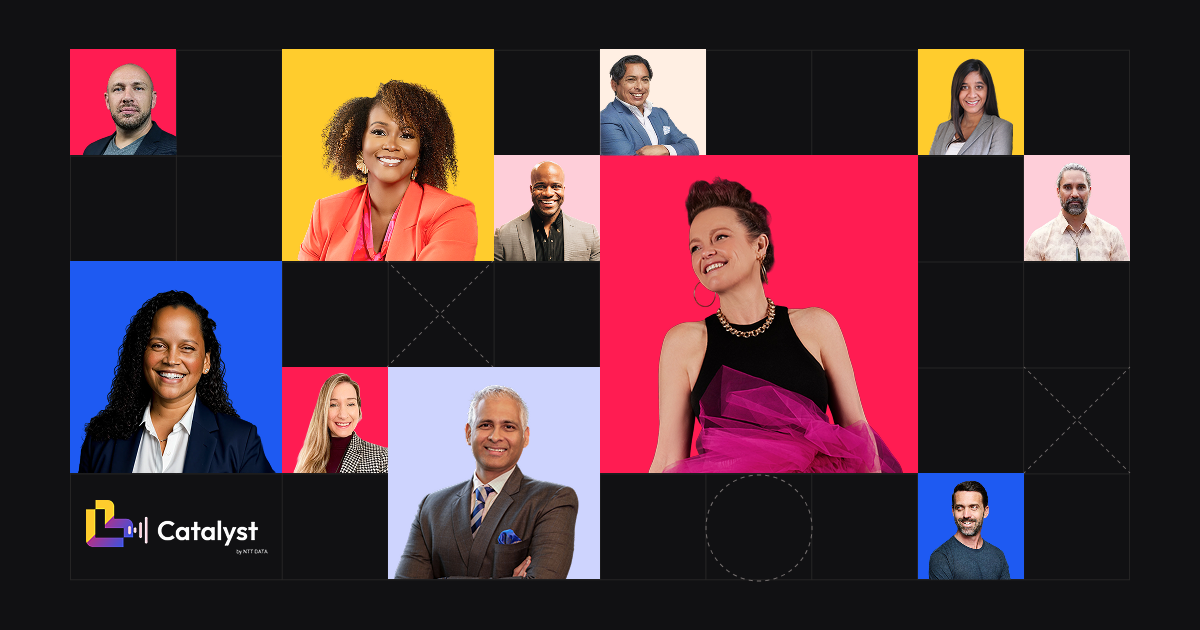
This year on Catalyst, I sat down with almost 50 incredible leaders, each with their own take on where we are collectively across technology, innovation, leadership and the human side of change.
I loved how each was unique, but the same underlying truth continued to come up. It’s always been about the humans.
That showed up clearly when Nimesh Mehta, Chief Information and Strategy Officer at National Life Group, told me the biggest mistake technologists make is not enrolling people as part of the change.
“You have to land WITH people, rather than land ON them.”
When I stepped back at the end of the year, this idea showed up again and again, taking shape across five themes. These became Catalyst 2025: Five themes that defined a year of transformation.
1. The human side of AI: Trust, fear and the work ahead
Much of enterprise AI has been rolled out through pilots and experiments that rarely make it to scale. The now-familiar MIT statistic showing that 95% of AI pilots fail was a much-needed reality check. When initiatives start and stop without clarity, people lose trust, confidence erodes, and skepticism sets in long before the technology has a chance to prove its value.
Noelle Russell, CEO of the AI Leadership Institute, spent years selling Microsoft AI back when most executives didn’t yet see the need for it. Her warning was clear:
“Not only will it do the stuff you love, but it’ll do the stuff you love in a mediocre way that you’ll eventually resent.”
The risk isn’t the technology itself. It’s what happens when leaders hand over decisions without intention. AI reflects the choices we make about what to scale, what to automate, and where humans still need to lead.
That’s where leadership comes in.
Jessica Hartley at JPMorganChase framed what that responsibility looks like in practice:
“At some point in leadership, you have to trust that you do not know everything, and your team is smarter than you. Your job is to build the platform, build the space, and make the connections so they can do the work.”
Across these conversations, a consistent tension came through. People aren’t afraid of AI itself. They’re reacting to losing control, losing creativity, or having tools imposed on them without clarity or care.
Jamie Sermon, VP of Engineering Robotics and Automation at UPS, offered an important counterpoint. “We’re not taking away any jobs,” he said. “We’re changing the way work is done.”
2. Authentic leadership: Courage, transparency and showing up as your whole self
Brant Beard, Assistant Vice President of Talent Growth at HCA Healthcare, talked about saying yes before he was ready and then immediately feeling the fear that follows. That “Oh crap. I’m going to fail” moment is where courage shows up. Not after confidence, but before it.
He was clear that the voice telling you that you don’t belong never fully goes away. What changes is your ability to quiet it enough to keep moving, stay present, and focus on what you’re actually good at instead of trying to be someone you’re not.
Donald Chesnut, Chief Design Officer at Candescent, shared a different but deeply connected perspective. After years as a Chief Experience Officer at companies like Mastercard and General Motors, he talked about walking into rooms as the only openly gay man among dozens of leaders and constantly managing how he might be perceived. Only when he brought his full self to work could he finally redirect that energy toward creativity, impact, and leadership.
Donald also spoke openly about sharing failures in town halls and naming his own shortcomings.
“Being truly open about your own shortcomings leaves room for other people to be truly open,” he said.
Together, these conversations reinforced that authentic leadership isn’t about fearlessness. It’s about honesty, presence, and creating space for others to show up fully too.
3. Designing with people, not just for them
Designing with people is a choice. It’s about being deliberate in how and when technology steps in, and clear about where humans matter most.
Donald Chesnut described that balance as intentional, not accidental. “It’s digitally human and deliberately human,” he said. The point isn’t automation for its own sake. It’s knowing when people actually need people.
That same intention shows up in how Donald thinks about customer-centered growth. He starts with loyalty, trust, and care, then works backward to the systems that support them. Growth follows, but it’s not the first move. The human experience comes first.
I heard the same instinct in how Jessica Hartley talks about leadership and culture. She argues for environments where people don’t have to perform a version of themselves just to belong, where they can do their best work because the space was designed with real humans in mind.
This is the shift that keeps showing up. Products, platforms, and workplaces all shape behavior. When we’re deliberate about that design, we create conditions where people and businesses perform better.
Sean Jantzen, VP of Applications Development at UPS, captured the “with, not for” mindset in a way that feels especially true inside complex enterprises:
“To me, it’s a partnership, and it has to be a partnership, otherwise it’s not going to be successful… there’ll be just a lot of finger pointing going on.”
That’s what designing with people really looks like in practice.
4. Reinventing work: Skills, teaming, and new ways of thinking
Jamie Sermon offered one of the clearest views I heard all year on how work actually gets reinvented. Not through sweeping change, but one person, one team, and one risk at a time.
He talked about the importance of creating safe spaces for teams, especially when people encounter problems they’ve never seen before. You can’t ask people to experiment if they feel alone or exposed when things don’t go as planned.
He also reframed experimentation in a way that works inside large organizations. If people think they’ll be punished for taking risks, they won’t take them. His mindset was simple: “We took the risk, so we’re going to make mistakes. What can we learn from this?” Then you move forward together.
Sean Jantzen added the operational lens of reinvention, describing how teams move away from big-bang perfection toward incremental learning. Instead of “polishing that apple until there’s immediate perfection,” he talked about smaller batch deployments where “the blast radius is smaller.”
That shift changes how teams collaborate, how quickly they learn, and how willing they are to take the next risk.
5. Technology as possibility
The gap between what’s possible and what’s real has never been smaller.
Back in her Microsoft days, Noelle Russell joked that she felt like she was “selling vegetables to kids.” Today, rolling out tools can happen in days. The real constraint is no longer access to technology, but imagination and clarity of vision. “It’s going to be the great equalizer,” she told me. “You do not have to be technical. It makes ideation your superpower, not necessarily the model that anyone can go use.”
Deanna Steele, CIO at Allied Universal, grounded that sense of possibility with discipline. In fast-moving moments, she emphasized the importance of stepping back and asking whether you’re still aligned with what you intended to do. As she put it, “there is no magic book of best practices… there’s no book… we make them up as we go along.”
Kainoa Horcajo pushed the idea of possibility even further, reminding me that technology without meaning is just noise. “You can circle words like you're doing a wine tasting… integrity, accountability, empathy, but the story, that’s what adds the flavor.”
The technology is here, and it can be a superpower. And yes, with great power comes great responsibility. The question now is how leaders use that power, and whether they bring people along in the process.
Catalyst returns in 2026
After spending a year inside these conversations, I’m very aware that we have so much more to talk about. Catalyst will still be talking all things AI, innovation and humanity in 2026, because we are still in the messy middle of the AI transformation, and this technology is moving faster than we can fully grasp. Until then, be bold, take risks and shine bright.
Episode hosts and guests