It starts before the outage: How human-centered AI rewires utilities




Utilities have historically been about keeping the lights on. That was a big job even before AI joined the conversation. Today, energy-hungry data centers are a hot topic, landing in an already complex utility landscape and growing affordability concerns.
At the center of all of this are people: a customer whose bill has spiked, a business owner trying to get their power restored, a customer service rep trying to help without the full context, or work teams dispatched without the right equipment to complete the job.
The "call" in utilities always comes because of something upstream, and its normally power or bill related. By starting with the humans, utilities can use technology to remove the friction that shows up long before the call is made or the truck rolls.
Pressure on the grid at a pivotal moment
Over the last two decades, the utility industry has been focused on grid modernization, as it prepares for a global energy transition. Distributed energy resources, energy efficiency programs and low-energy products have helped curtail load demand, while supporting economic growth and customer choice. But the past five years has changed that narrative.
In 2026 we are seeing three issues converging that are top of mind for utilities:
- Growth in load demand
- Constraints on existing grid infrastructure
- Growing concerns about customer affordability
As these challenges meet, utility customers and workers are caught in the middle.
Balancing innovation with the needs of everyday customers
In 2026, the U.S. utility sector is caught in what some have called a "perfect storm", with three forces colliding faster than the regulatory and physical infrastructure can adapt. Annual data center investment in the United States has reached $425 billion, with roughly 70% flowing from the hyperscale developers.
The increased adoption of AI has added load; as well as transformed what load looks like. While traditional server racks typically draw 3 to 5 kilowatts of power, AI-optimized server racks can demand up to 100 kilowatts. It is now believed that global data center projects under development will further increase demand by 100 gigawatts by 2030, with roughly half landing in the United States.
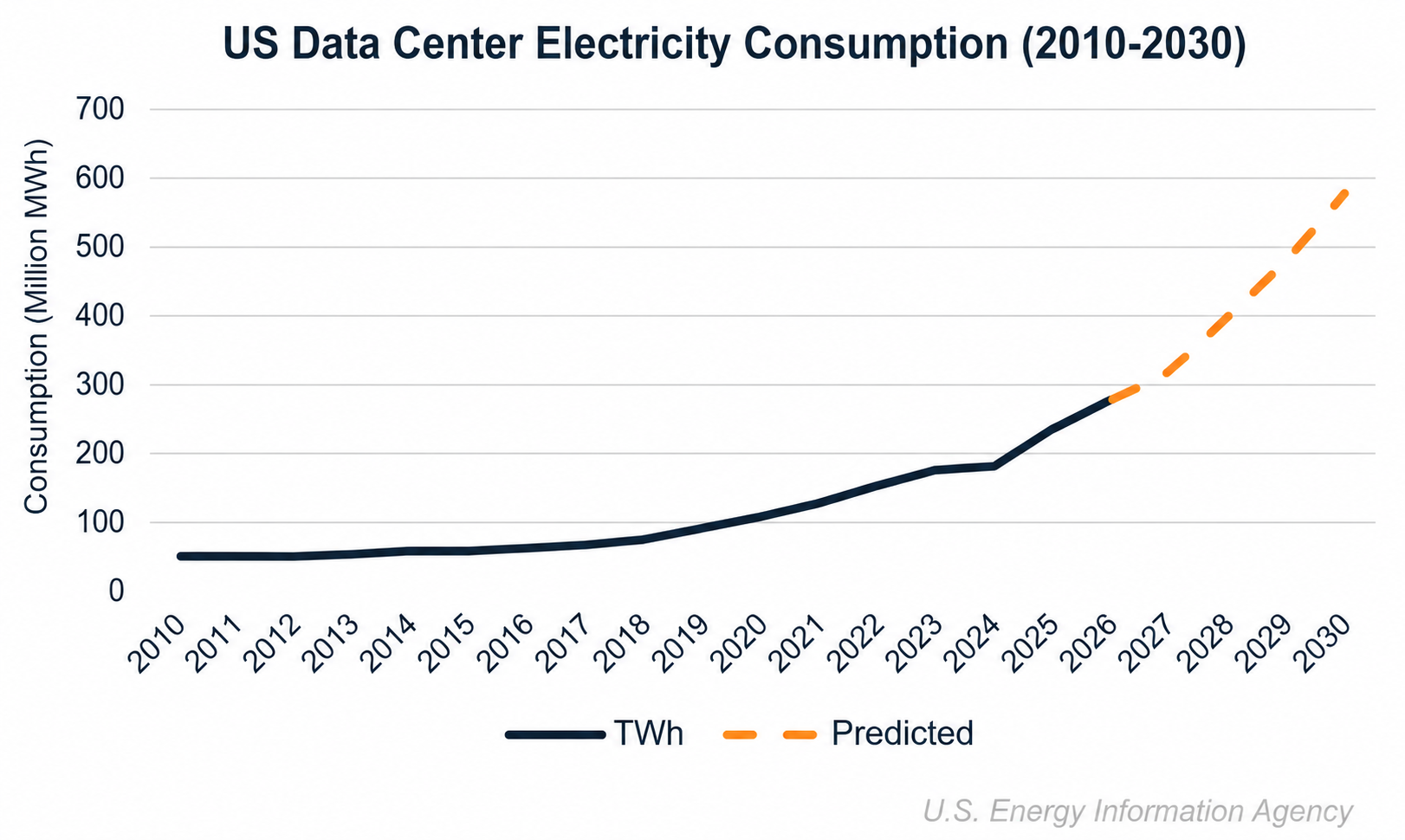
Beyond the implications for energy, data center water consumption is also projected to hit 350 billion gallons annually by 2028, a number that turns location decisions into watershed and crop management decisions. These choices are made not in Washington but across roughly 35,000 local authorities, each with its own zoning code, comprehensive plan and political climate. The state of Maine's recent legislative friction over data center moratoria may be a preview of what’s to come, as more communities across the US struggle to balance the economic, social and environmental benefits of these projects.
The race to power the AI economy
While roughly 3,000 data center projects sit in the proposal queue, US utilities are investing a record $202 billion in infrastructure in 2026 to keep up.
The most revealing change is what developers now optimize for. Price used to dictate where data centers were located. Today, it’s about speed-to-power and how quickly a site can actually energize. Construction timelines for large data centers can range from 24 to 72 months, with about 2,000 GW of generation capacity stuck in current interconnection queues. Texas has seen large-load requests jump 300% year-over-year in 2025, though everyone in the industry knows a meaningful share of that is speculative hedging by developers placing options on multiple sites. To push back on speculation within the interconnection process, some utilities have raised their interconnection review fees.
The vocabulary has also evolved with the math. A "large load" used to mean 10 to 25 MW. The current benchmark now starts at 50 MW, and regulators are reacting, with 29 large-load tariffs approved last year. But the gap between "shovel-ready" and "power-ready" is now the limiting factor of the entire build-out.
The rising cost of keeping the lights on
The third pressure on utilities is the one that is starting to be discussed more between regulators, at industry conferences and certainly around kitchen tables. Customer collections across U.S. utilities have climbed to $28 billion in 2026. This is comparable to peak pandemic levels, when total arrears rose to $31 billion. Fourteen million Americans have entered credit and collections this year. That’s nearly one-in-six US customers behind on their utility bill. In New York alone, 1.4 million customers owe a combined $2.4 billion.
This has grown beyond a low-income story. New customer classes are slipping into delinquency as average monthly bills in some regions cross $250+. Economists have been describing a “K-shaped” economy that is now visible in macro terms and on utility ledgers.
Designing solutions around people, not just infrastructure
To get ahead of unprecedented load growth, some of our utility clients are developing AI-driven tools to identify and forecast large-load impacts earlier — flagging when and where new data centers and industrial facilities will stress the grid before formal study queues catch up. They are also pairing these capabilities with new collaboration strategies, engaging developers, site selectors and local planners upstream so siting, infrastructure and interconnection timelines are coordinated rather than negotiated after the fact. The result is a more proactive model of grid planning, one that anticipates load instead of reacting to it.
Innovative rate design has to land at the same time. Large-load tariffs need to cover the costs of new hyperscale demand without using residential customers as the shock absorber. That means cost causation that holds up under scrutiny and structures that let industrial users pay for the speed they actually need.
Building a grid that works for both growth and people
We believe the next four years will determine the shape of the next forty. AI infrastructure is being sited, permitted and energized right now, on terms being set right now. So are the rate cases that will define affordability for a generation of households.
Data centers are not just energy consumers. They are becoming key pillars to the modern economy. They need to coexist with a grid that remains stable and a customer base that can still afford to keep the lights on.
While the growth of artificial intelligence is part of the pressure utilities now face, it can also be part of the solution. When applied selectively, AI can handle the heavy operational load of tier-one customer inquiries, usage analysis and program recommendations, route optimization and dispatch scheduling for field crews, and grid health monitoring and equipment failure prediction. AI can free humans to do what we do best in this context: tasks that require judgment and complex decisions that require human accountability.